
Abraham Lincoln
“With
malice toward none; with charity for all; with firmness in the right, as God
gives us to see the right, let us strive on to finish the work we are in; to
bind up the nation’s wounds…. “
– Abraham Lincoln
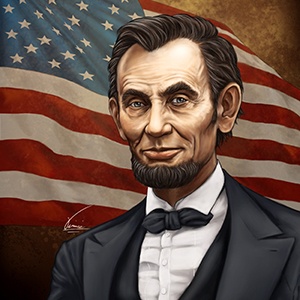 Abraham Lincoln was born Feb 12, 1809, in
Hardin Country, Kentucky. His family upbringing was modest; his parents from
Virginia were neither wealthy or well known. At an early age, the young Abraham lost his mother and his
father moved away to Indiana. Abraham had to work hard splitting logs and other
manual labor. But, he also had a thirst for knowledge and worked very hard to
excel in his studies. This led him to become trained as a lawyer. He
spent eight years working on the Illinois court circuit; his ambition,
drive and capacity for hard work were evident to all around him. He also had a
good sense of humor and was depreciating about his looks.
Abraham Lincoln was born Feb 12, 1809, in
Hardin Country, Kentucky. His family upbringing was modest; his parents from
Virginia were neither wealthy or well known. At an early age, the young Abraham lost his mother and his
father moved away to Indiana. Abraham had to work hard splitting logs and other
manual labor. But, he also had a thirst for knowledge and worked very hard to
excel in his studies. This led him to become trained as a lawyer. He
spent eight years working on the Illinois court circuit; his ambition,
drive and capacity for hard work were evident to all around him. He also had a
good sense of humor and was depreciating about his looks.
“If I
were two-faced, would I be wearing this one?”
He married Mary Todd and had four children, although three died before
reaching maturity.
As a lawyer, Abraham developed a great capacity for quick thinking and
oratory. His interest in public issues encouraged him to stand for public
office. In 1854 he was elected to the House of Representatives and he tried to
gain nomination for the Senate in 1858. Although he lost this election, his
debating skills caused him to become well known within the Republican party. In
particular, during this campaign he gave one of his best remembered speeches.
A house divided against itself cannot stand.
I believe this government cannot endure, permanently, half slave and half free.
I do not expect the Union to be dissolved — I do not expect the house to fall —
but I do expect it will cease to be divided. It will become all one thing or
all the other. Either the opponents of slavery will arrest the further spread
of it, and place it where the public mind shall rest in the belief that it is
in the course of ultimate extinction; or its advocates will push it forward,
till it shall become lawful in all the States, old as well as new — North as
well as South.
In this House divided speech, Lincoln gave a prophetic utterance to the
potential for slavery to divide the nation.
The reputation he gained on the campaign trail caused him to be elected
as Republican nominee for President in 1860.
The election of Lincoln as President in 1861, sparked the South to
succeed from the North. Southern independence sentiment had been growing for
many years and the election of a president opposed to slavery was the final
straw. However, Lincoln resolutely opposed the breakaway of the South and so
this led to the American civil war. The civil war was much more costly than
many people anticipated and at times Lincoln appeared to be losing the support
of the general population. But, he managed to keep the Republican party
together, stifling dissent by promoting the various Republican factions into
the cabinet. Lincoln oversaw many of the military aspects of the war and
promoted the general Ulysses S Grant to oversee the northern forces.
 Initially the war was primarily about succession and the survival of the
Union, but as the war progressed Lincoln increasingly made the issue of ending
slavery paramount. To Lincoln, slavery was fundamentally wrong.
Initially the war was primarily about succession and the survival of the
Union, but as the war progressed Lincoln increasingly made the issue of ending
slavery paramount. To Lincoln, slavery was fundamentally wrong.
“Whenever I hear anyone arguing for slavery,
I feel a strong impulse to see it tried on him personally.”
On January 1, 1863, Lincoln issued his memorable Emancipation
Proclamation that declared the freedom of slaves within the Confederacy.
“… all persons held as slaves within any
State or designated part of a State, the people whereof shall then be in
rebellion against the United States, shall be then, thenceforward, and forever
free; and the Executive Government of the United States, including the military
and naval authority thereof, will recognize and maintain the freedom of such
persons,…”
Eventually, after four years of attrition, the Federal forces secured
the surrender of the defeated south. Lincoln had saved the union and also
brought to head the end of slavery.
Dedicating the ceremony at Gettysburg on November 19, 1863, Lincoln
declared:
“that we here highly resolve that these dead
shall not have died in vain–that this nation, under God, shall have a new birth
of freedom–and that government of the people, by the people, for the people,
shall not perish from the earth.”
Lincoln was tragically assassinated by John Wilkes Booth, an actor on,
April 14, 1865. He is widely regarded as one of America’s most influential and
important presidents. As well as saving the union, Lincoln was viewed as
embodying the ideals of honesty and integrity.


